

More about: Seville in 5 Day: a guidebook for getting the most out of your visit
When organising a trip, it can sometimes be difficult to plan each day, especially with so many things to see and do in a city like Seville. The good news is that, as you'll be spending five days in the city, you'll have plenty of time to see everything in detail, especially if you follow my advice and the daily itineraries I've prepared.
Day 1: Discover the most important and popular places in Seville

I'm sure you're full of energy and eager to start your visit to Seville, so for this first day, it's best to tick off those places that, due to their importance, you simply must visit, such as the Alcázar or the Cathedral. Shall we begin?
Spend the morning exploring the Royal Alcázar of Seville
There are few better places to start your trip than the Royal Alcázar of Seville. This palace complex, located in the historic centre of the city (specifically, you enter through the Plaza del Triunfo), is one of its emblems.
You can book your ticket for the Alcázar from ₹2,314, but you can also book a guided tour of the Alcázar, the Cathedral and the Giralda in Seville. Keep this in mind because these two places are also part of your first day's itinerary.
Visiting the Alcázar of Seville is like entering a fairytale palace, where different architectural styles blend together. My advice is to take your time visiting it, spending time walking through its gardens, which you may recognise from an episode of Game of Thrones.
Stroll through the Murillo Gardens before lunch
Leaving the Alcázar, you will find the Murillo Gardens and their gazebos, decorated with ceramics, bricks, fountains and lots of vegetation.
Although they are now a public space, they were previously part of the palaces, hence their proximity. In fact, right at the entrance to the gardens you can see part of the old Alcázar walls.
In addition to orange trees, magnolias and other tree species, in these gardens you will find sculptures representing illustrious citizens of Seville and Spain, such as the Catholic Monarchs and the literary character Don Juan Tenorio.
Take a tapas tour of the Santa Cruz neighbourhood

After a morning spent at the Alcázar and its gardens, you'll surely want to stop for a bite to eat. The good news is that you're in one of the best neighbourhoods in Seville: Santa Cruz.
As it can sometimes be difficult to choose just one bar, I recommend booking a tapas and flamenco tour of Seville, which includes a complete tour of the best places in the area, where you can try typical tapas accompanied by a specialist guide.
They say that one of the best ways to get to know a city and its culture is through its cuisine, so why not give it a try? Afterwards, you can take a stroll through Seville's Santa Cruz neighbourhood.
Enter Seville Cathedral and climb the Giralda
After lunch, it's time to resume your itinerary and book your ticket to the Cathedral and the Giralda, which are also located in the Santa Cruz neighbourhood. The Cathedral is the largest Gothic temple in the world and the Giralda is the former Almohad minaret that later became a Christian bell tower.
The exterior portico of Seville Cathedral is one of the elements that will most catch your attention, although the great treasures are inside (if you don't believe me, wait until you see the Patio de los Naranjos or the sacristies).
Of course, the visit is complete with a climb to the top of the Giralda. Don't worry about there being lots of steps, because what you'll find is a long ramp that the former sultan decided to install so that he could ascend on horseback.
End the day with a visit to the Hospital de los Venerables
In the 17th century, there was a desire to build a place where elderly priests, impoverished by the plague, could retire. Thus, the Hospital de los Venerables was born, although today it has been converted into a museum that houses one of the finest collections of works by the painter Diego Velázquez and other contemporaries (such as Murillo and Zurbarán).
I highly recommend visiting; it is about 5 minutes from the Cathedral and admission is only about €5.
In addition to the art centre, the Hospital de los Venerables also has a beautiful church in the purest Sevillian Baroque style and a central courtyard where you can sit and rest for a while after a day of visiting the city.
Day 2: Discover the secrets and history of Seville

On the second day, I suggest you discover some of Seville's secrets, including buildings that are not always visited but are spectacular, as well as places that hold a lot of history.
Amongst all the information and facts, there will also be time to be outdoors and enjoy the city from above.
Immerse yourself in history through the Archivo de Indias
Seville is a city steeped in history, but if I had to name one place where this is most evident, it would be the Archivo de Indias.
Admission is free and it is located in the centre, near María Luisa Park, making it a good place to start your second day in Seville. It houses documents of great value, such as the contract signed by Christopher Columbus with the Catholic Monarchs, as well as many other maps, drawings and diaries from those early voyages to America.
Its original use was as a Lonja, or market, a place for merchants to conduct their business and trade. However, over time it became the Casa de Contratación (House of Trade) and then, in 1785, the documentation centre for everything related to the Spanish presence in America.
Visit the Royal Tobacco Factory inside and out
To start the second day in Seville, I thought there was nothing better than discovering one of the city's hidden treasures: the Royal Tobacco Factory.
This stone building, located next to the Alcázar and currently the rector's office of the University, may not particularly catch your eye, but you should know that it was the first tobacco headquarters established in Europe, back in the 18th century.
Its design is one of the best examples we have of the architecture of the Old Regime. If you are surprised by its size, it is not surprising: the building is second only to the palace of El Escorial in terms of size. You can visit the interior free of charge, especially at times when there are no university classes (weekends and midday).
Sit on the large bench in Plaza de España
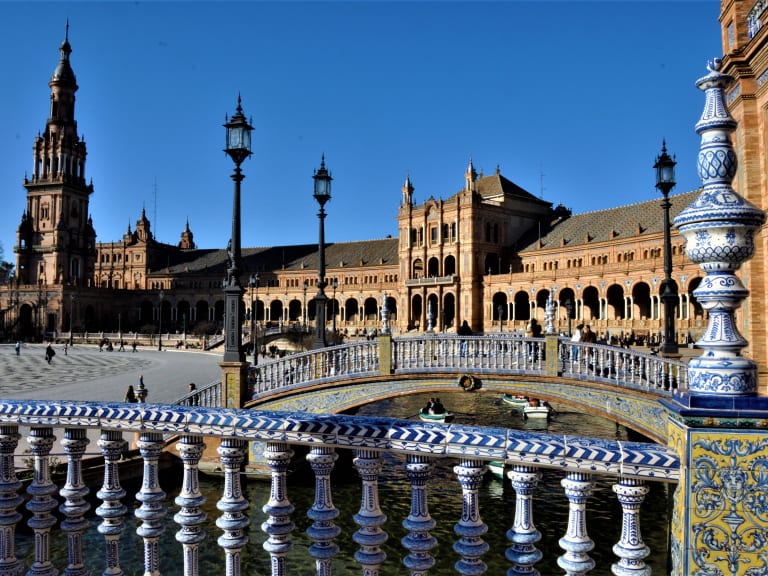
You may be in Seville, but when you arrive at Plaza de España, you will feel that all the provinces of the country are welcoming you. How? Through the large bench that crosses this square, which is only ten minutes from the Royal Tobacco Factory.
Through detailed and beautiful tile work, the different cultures of the country are represented on the bench.
Beyond this, Plaza de España is a must-see if you are in Seville. In addition to the institutional buildings there, the most striking features are its two towers, which can be seen from various points in the city. I recommend booking a tour of Plaza España, where you will discover all the secrets of this emblematic place and also take a walk through the covered gallery that connects the two towers.
Buy a snack at the stalls in María Luisa Park
With your back to the towers of Plaza de España, you will find yourself in María Luisa Park, your next destination.
In addition to strolling along its paths and among its plants, fountains and statues, I recommend visiting one of the food stalls and ordering something to eat. I'm sure you're feeling hungry by now! If you prefer to sit down in a restaurant, there are plenty to choose from, and the views are truly unbeatable.
María Luisa Park is one of the largest in the city and, being in the centre, acts as a meeting point for Sevillians. It was designed in the purest English style, so eating or walking there will make you feel like a true aristocrat. If you want to discover all its secrets, be sure to book a tour of María Luisa Park.
End the day at the top of the Torre del Oro
To end the day, how about watching the sunset over Seville from the Torre del Oro? It costs approximately £3 to go up and is worth it at any time of day, but when the sun goes down, I have to say that seeing the city from 36 metres up is quite a spectacle.
Although it has now become one of the best viewpoints in Seville, the Torre del Oro originally had a defensive function, which is why it was built on the banks of the Guadalquivir River.
Take a boat trip on the Guadalquivir
When you're done, I recommend booking a boat trip around Seville. Most of these cruises depart from the Torre del Oro pier, so you can take advantage of being there to end the day with a beautiful tour of the Guadalquivir River. They cost approximately €20 and are well worth it; you'll see Seville from a different perspective.
The Guadalquivir is part of Seville's culture. Its waters cross the city, dividing it in two, so sailing along them means you can see important buildings on both banks. In addition, you will have the explanations of a guide who will reveal the secrets and most local aspects of the city.
Day 3: Cross the Guadalquivir to La Cartuja and Triana

Although you have always been on the left bank of the Guadalquivir until now, on the third day I suggest you cross the river and head to the right bank, where you will find the modernity of Isla de la Cartuja and the tradition of the Triana neighbourhood.
Visit the most modern part of Seville on Isla de la Cartuja
Although the other days have started in the centre of Seville, on this third day you will have to travel (by bus on lines C1 or C2, because it is more than half an hour's walk from the centre) to Isla de la Cartuja, an area built for the 1992 Universal Exposition and which is now a Technology and Science Park with a wide range of leisure activities.
My advice is to spend part of the morning visiting Alamillo Park, the largest in Seville and home to many plant and bird species. Then continue on your way, passing in front of the Caixa Forum, where you can go in to see some interesting exhibitions, and the Tower of Seville, where Isla de la Cartuja ends and the Triana neighbourhood begins. If you prefer, you can take the C3 bus to get there.
Contemplate the rich simplicity of the Capilla del Carmen
Once in the Triana neighbourhood, you can make your first stop at the Capilla del Carmen. Don't be fooled by its small size; there are few buildings more curious and beautiful than this one. Its design is the result of the work of an architect and a ceramist, hence the mixture of colours and the use of brick as the main element.
Although you can simply view it from the outside, I recommend going inside (admission is free) to see the artistic works created with tiles. The Capilla del Carmen is considered one of the entrances to the Triana neighbourhood, so let its octagonal bell tower and dome welcome you.
Taste the best Andalusian dishes at the Triana market

After walking all morning, I'm sure you're hungry and ready for a break. How about stopping at the Triana Market?
Located on the ground floor of the former Inquisition court (the Castle of San Jorge), this market is a great place to go for tapas, as there are small taverns in addition to stalls selling fresh produce. Another option if you want to sample the best dishes is to book a tapas tour of Triana.
Also known as the Plaza de Abastos, the Triana Market is very popular for its culinary and historical value, as the remains of the castle are open to visitors. This is a great (and free) thing to do after tapas, don't you think?
Visit and get to know the Triana neighbourhood
There is a lot to see in Seville's Triana neighbourhood, so I suggest spending the afternoon exploring it and immersing yourself in its art, culture and atmosphere. In addition to the Capilla del Carmen and the Market, there are other places I would like to recommend, which you can easily reach by wandering around the neighbourhood.
Be sure to see the Plaza del Altozano, the Murillo Pharmacy building and Calle Betis, one of the most important streets in Triana because it offers stunning views of Seville from the other side of the Guadalquivir River. And before you finish your walk, step into one of the typical Triana courtyards, always decorated with plants.
One option for visiting comfortably is to book a private tour of Seville.
Get excited at a flamenco show
The Triana neighbourhood has been the birthplace of many singers and dancers, which is why it is one of the best areas to enjoy a flamenco show in Seville. It is an experience not to be missed if you are in Seville; the rhythms of the dance, the heel tapping and the guitar come together in a unique live cultural show.
If you want to discover the real Seville, you have to book a flamenco show in Triana. As these venues aim to maintain the intimacy and emotion of this art form, places are limited and it is best to book in advance.
Day 4: A tour of the city centre and the banks of the Guadalquivir

Although the trip is coming to an end, there are still several places you should visit in Seville. That's why the fourth day focuses on such iconic buildings as the Maestranza and the Reales Atarazanas, as well as the banks of the Guadalquivir.
Spend the morning exploring Italica, the Roman ruins of Seville
Have you heard about the Roman ruins in Seville? Now that you know they exist, I'll explain how to get from Seville to Italica, where they are located. It's a very interesting visit, as you'll discover what was once one of the great Roman cities. The best way is to book an excursion to Italica, as from €41 you get direct transport and a tour with a specialist guide.
If you prefer to go on your own, you will have to take one of the two bus routes (the M-170A and the M-170B) that connect the centre of Seville (Plaza de Armas) with Italica. The price is around €2 each way. Access to the ruins is free for EU citizens (non-EU citizens will have to pay approximately €2).
Once in Italica, get ready to step back into the Roman Empire. You can visit the ancient amphitheatre and the houses where its inhabitants lived; everything is fairly well preserved, although I recommend also visiting the museum to see other objects that were used at the time, as well as other archaeological treasures.
Discover the function of the Royal Shipyards
Don't know what the Royal Shipyards of Seville are? When you return from Italica, I recommend you go inside (it's free). Its large size will give you a clue as to the function of this place; it is where ships were built, especially at a time when they were sailing en masse to America.
This large factory is located very close to the Torre del Oro and just one metre above the water level of the Guadalquivir River, which facilitated the departure of ships.
The building, like many others in Seville, combines Gothic and Mudejar styles. What is most striking is its immense interior, where different ships are connected. Fishermen, sailors, gunners, etc. worked here for many years.
Buy antiques and stroll around the Plaza del Cabildo

Just a three-minute walk from the Royal Shipyards is the Plaza del Cabildo. This place always has visitors, but if you happen to go on a Sunday, it will be busier than usual, as this is when Seville's numismatic and collectors' market is held.
In any case, whatever day you go, this square has always had many antique shops, so if you are looking for an original gift to take home from Seville, you are in the right place.
The square is semi-circular in shape, as is the building in it. It has three floors (all of them curved) and is famous for its balconies, painted and decorated by the painter José Palomar. It is undoubtedly a good place to take a photo and have a look around. And from there you can book a tour of the Jewish quarter.
Sit on the banks of the Guadalquivir to have something to eat
Although you're sure to find plenty of restaurants to sit down and eat in the area, I recommend grabbing something to take away and heading to the banks of the Guadalquivir. There are benches all along the Paseo de Cristóbal Colón where you can watch the river (and the Triana neighbourhood on the other side) while you fill your stomach.
When you're done, take a stroll as you head to your next destination: the Plaza de la Maestranza.
Visit the Plaza de la Maestranza
Plaza de la Maestranza is the oldest of its kind, and even if you don't plan on attending a bullfight, you may still be interested in seeing it. In fact, it is one of the most visited places in Seville. Perhaps seeing it from the outside is enough, although you can go inside for approximately €10.
The architectural feature that usually attracts the most attention to everyone who enters is the interior façade (the Palco del Príncipe), which is topped by a half-vault finished with tiles.
Contemplate Seville illuminated from the Muelle de la Sal
There are few sights more beautiful than the Triana neighbourhood lit up from the Muelle de la Sal. Its name, as you can imagine, comes from the fact that it was the place where salt was unloaded.
Today, it is like a balcony from which to observe the other side of the river. If you find the view beautiful, imagine how it would be to extend it with a boat trip through Seville at nightfall.
If you travel to Seville in summer, you will find this place busier than ever, as many people come here to enjoy the night breeze of the Guadalquivir after a hot day.
Day 5: End your trip in the most noble part of Seville

The trip is coming to an end, but before you leave Seville, you may want to discover its most affluent side, where the houses of ancient noble families mingle with neighbourhoods full of modern establishments.
Discover Seville's treasure in the Basilica of La Macarena
Start your last day with a visit to the Basilica de la Macarena, home to one of Seville's most beloved treasures: the Virgen de la Esperanza.
It is located in the San Gil neighbourhood, opposite the Andalusian Parliament, and you can enter for free, which I highly recommend, especially to see the chapels. However, if you want to enter the museum, you will have to pay approximately €5.
Architecturally, the basilica has only one nave and consists of a single floor. Its interior was decorated with marble of various colours and Baroque elements, so expect to see a lot of ornamentation.
Enter the aristocratic Palacio de las Dueñas
Although many years ago there was a monastery (from which it also took its name) where the Palacio de Las Dueñas now stands, this place has always been the residence of Seville's most noble families. Since the 17th century, it has been the residence of the House of Alba.
As you can see, its historical value is very high, but if you book your ticket for the Palacio de las Dueñas, you will be able to admire a great deal of art. Taking Calle San Luis from the Basilica de la Macarena, you can get there in less than 15 minutes.
Beyond the private rooms, ballrooms and courtyards that can be visited, I recommend going to the Palacio de las Dueñas because it acts as a great museum of works by painters such as Sorolla, luxurious tapestries and other archaeological remains.
Take a break to try Seville's most innovative tapas
As soon as you leave the Palacio de las Dueñas, you will find yourself in the Encarnación-Regina neighbourhood, which is steeped in history and also has a lot to offer in terms of gastronomy. I recommend stopping at one of the restaurants in the area, which offer innovative dishes, or booking a tapas and flamenco tour of Seville.
If you like trying new things, you'll be spoilt for choice here. What was a somewhat run-down neighbourhood a few years ago has now been renovated and modernised, full of establishments offering delicacies and reinventing traditional tapas.
Take a panoramic tour of the Setas de Sevilla
In the heart of Plaza de la Encarnación are the famous Setas de Sevilla. I know the name is strange, but when you arrive at this modern monument, you'll understand that its shape is reminiscent of that food. The Setas are actually a structural complex formed by a large pergola.
In addition to their design, they are known because from their walkways, which reach 26 metres, you can see the old town of Seville. The truth is that visiting the Setas is a great way to end your trip and say goodbye to the city.
Discover the Andalusian architecture of the Casa de Pilatos

Just ten minutes from Las Setas de Sevilla is the Casa de Pilatos, another noble residence built in a very Andalusian style. This particular palace was home to the Dukes of Medinaceli from 1639, although it is renowned for marking the start of Seville's Holy Week and for its colourful interior.
As you read, in the 16th century, a Via Crucis (a path of prayer) began to be celebrated, starting from the Casa de Pilatos and ending in the Seville neighbourhood of Nervión. Over the years, this path evolved into what are now the Holy Week processions. Several Roman sculptures are on display in the palace's inner courtyard, so it is worth paying the entrance fee (approximately €10) to see them.
End your trip to Seville in Plaza de El Salvador
I know you don't want it to end, but I promise you that if you have dinner in the area around Plaza del Salvador, in the Alfalfa neighbourhood, you won't leave with a bad taste in your mouth. This square is less than 10 minutes from the Casa de Pilatos and is full of terraces with views of the cathedral and the Giralda, which will be illuminated at that time of night. Say goodbye to them over dinner.
This area has been a meeting point for many years. Its social character, which is now more evident as it is completely pedestrianised, dates back to the 17th century. Today, it maintains that spirit and is one of the best neighbourhoods to get to know the culture of Seville through its tapas and typical dishes.
Getting around Seville: do you need to buy a travel card?
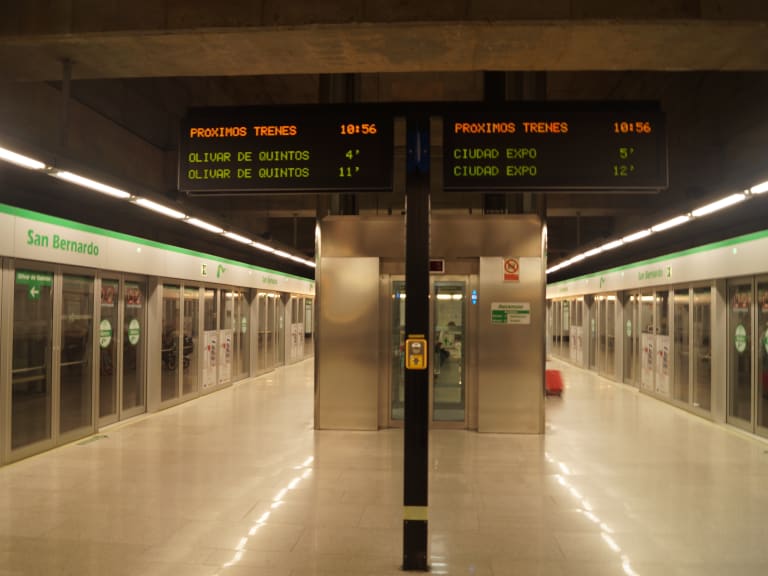
As you may have realised, there are many things to see and do in a city like Seville, so it is very important to plan your trip meticulously and not waste time travelling. If you have been looking for information on the best way to get around Seville, you will already know that you can reach many places on foot.
However, you can always take the bus to places that are further away, either because they are not in the centre (such as Isla de la Cartuja) or because they are not close to your hotel. Although there is a metro, there is only one line, whereas there are fifty bus routes, allowing you to travel from one side of the city to the other. Bear in mind that if you follow the itinerary I have suggested and your accommodation is central, you will only need to take the bus occasionally, so it is better to buy a single ticket (approximately €1.50) when you do.
If your hotel is on the outskirts, you may need to use public transport more often, in which case it would be more cost-effective to buy a tourist card for the Seville bus (€5 for 1 day and approximately €10 for 3 days, plus a €1.50 deposit); the good thing is that you can make unlimited journeys with these cards. I hope you enjoy your trip to Seville and that my tips help you organise 5 days of art, culture and history.